Pledges and Profits: How Corporate Donors Are Funding the Erosion of Reproductive Rights Behind Closed Doors
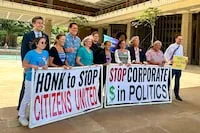
Photo: corporate boardroom women's rights political donation protest, via www.washingtonpost.com
Every October, corporate America turns pink. Logos are updated. Press releases celebrate women in leadership. Human resources departments circulate memos about pay equity audits and expanded maternity benefits. The messaging is consistent, polished, and — in too many cases — profoundly dishonest.
Because while these companies craft narratives about standing with women, their political action committees are writing checks to the very legislators stripping women of the most fundamental right of all: control over their own bodies.
This is the abortion ban loophole that almost no one in Washington wants to talk about. And it is long past time we named it for exactly what it is.
The Gap Between the Press Release and the Donation Record
Federal Election Commission filings are public documents. They are also, for most Americans, deeply inaccessible — buried in databases, cross-referenced across dozens of affiliated entities, and deliberately difficult to trace back to a recognizable corporate name. That is not an accident.
When researchers and investigative journalists do the painstaking work of connecting the dots, the picture that emerges is damning. According to data compiled by campaign finance watchdog organizations, a significant number of corporations that have publicly endorsed reproductive health access — through statements, employee benefit expansions, or membership in pro-women business coalitions — have simultaneously directed PAC contributions to legislators who voted for near-total abortion bans, gestational limit restrictions, and legislation targeting abortion providers.
Some of the most recognizable names in American retail, finance, pharmaceutical manufacturing, and technology appear on both lists. They sponsor women's leadership conferences in the spring. They donate to anti-abortion incumbents before the fall elections.
How the System Makes This Possible
The architecture of American campaign finance is uniquely suited to this kind of institutional hypocrisy. The Supreme Court's 2010 decision in Citizens United v. FEC opened the floodgates for unlimited independent expenditures from corporations and other outside groups, while subsequent rulings have further eroded disclosure requirements that might hold donors accountable.
Corporate PACs operate with a degree of separation from brand identity that most consumers never see. A company's political action committee is technically funded by voluntary contributions from executives and employees — but in practice, the PAC's strategic direction reflects the priorities of senior leadership. When a PAC donates to a politician with a consistent record of opposing reproductive rights, that is a deliberate institutional choice.
The anonymity available through intermediary organizations — so-called "dark money" nonprofits that are not required to disclose their donors — makes the problem even more acute. A corporation can fund a 501(c)(4) advocacy group, which in turn funds political advertising supporting a candidate who campaigns on banning abortion with no exceptions. The money moves. The candidate benefits. The corporate logo stays clean.
This is not a hypothetical. It is a documented pattern.
What the Politicians Are Actually Voting For
It is worth being precise about what this corporate money is enabling. Since the Supreme Court's 2022 decision in Dobbs v. Jackson Women's Health Organization overturned the federal constitutional right to abortion established in Roe v. Wade, more than a dozen states have enacted bans or severe restrictions. Several of those laws contain no meaningful exceptions for rape, incest, or the health of the pregnant person — only narrow exceptions for life-threatening emergencies that have proven, in practice, to be nearly impossible for physicians to invoke without fear of criminal prosecution.
The legislators who voted for these laws, who championed them, and who have promised to pursue a national abortion ban did not arrive at their positions in a vacuum. They were recruited, funded, and re-elected with money from political networks that corporate PAC dollars help sustain.
When a woman in Texas is denied emergency care because her physician fears prosecution, there is a chain of financial accountability that runs from her hospital room directly back to corporate boardrooms in cities where those same corporations sponsor women's empowerment luncheons.
The Argument Companies Make — and Why It Falls Short
Corporate representatives, when pressed, tend to offer a standard set of defenses. They donate across party lines, they say. They support candidates based on a broad range of policy considerations — tax structure, regulatory environment, trade policy — not solely on social issues. They argue that a single issue should not define the totality of a political relationship.
This argument deserves a direct response: when the issue in question is whether half the population retains bodily autonomy, it is not a peripheral policy consideration. It is foundational. A corporation cannot credibly claim to value women as employees, customers, and leaders while simultaneously funding the political careers of legislators whose explicit legislative goal is to reduce women's legal personhood.
The "broad portfolio" defense also ignores the signal that campaign contributions send. Politicians read their donor lists. They understand who is investing in their viability. When a corporation donates to a legislator who has made abortion restriction a defining feature of their platform and their public identity, the message received is one of endorsement — regardless of what the donor claims their motivation was.
What Accountability Could Actually Look Like
Real accountability in this space requires action on multiple fronts.
First, federal campaign finance law must be reformed to mandate comprehensive, timely disclosure of all political spending — including dark money contributions — so that voters and consumers can make genuinely informed decisions. Legislation like the DISCLOSE Act, which has repeatedly passed the House and been blocked in the Senate, would be a meaningful starting point.
Second, shareholders have both the standing and the responsibility to demand that corporate political spending align with stated values. Environmental, social, and governance frameworks that include political contribution audits are increasingly common, but they remain voluntary and inconsistently applied. They should be required.
Third, consumers have real power — and increasingly, they are using it. Brand accountability campaigns have demonstrated that corporate behavior responds to public pressure when that pressure is sustained, specific, and tied directly to purchasing decisions.
And fourth, Congress must be willing to pass legislation that restores and codifies the federal right to abortion access. The Women's Health Protection Act would accomplish this. It has Democratic support. What it has lacked is the political will — and the Senate majority — to advance it.
A Voice That Cannot Be Purchased
Shireen is running for Congress because the interests of working women, families, and communities deserve a representative whose commitments are not for sale. The campaign finance system as it currently exists allows powerful institutions to speak out of both sides of their mouths — celebrating women publicly while quietly funding the dismantling of women's rights.
That contradiction has real consequences for real people. It determines whether a woman in a rural county can access reproductive healthcare. It shapes whether a physician can provide evidence-based treatment without fear of incarceration. It defines the boundaries of freedom itself.
Corporations should be held to the same standard of honesty we expect from individuals. If you believe women deserve full autonomy over their own lives and bodies, then you do not fund the politicians working to take that autonomy away. It is not complicated. It is simply a matter of whether your values are genuine or merely convenient.
American voters deserve a Congress willing to say that plainly — and to legislate accordingly.